

Productivity is the key to prosperity
Increased productivity can lead to higher wages and household incomes, stronger
businesses, better public services and a higher standard of living.
-

- About
Productivity is about working smarter, not harder. It is about using resources in the most optimal way to realise the best outcomes and a build more inclusive national economy, so that it benefits more people, firms and places.

Find out more
The Productivity Institute has produced a number of resources to help explain what productivity means for the economy, business and places. They also detail how productivity has evolved from the concept of measuring inputs to outputs to measuring resources and outputs.

Blog: The Productivity Agenda Needs to be Joined Up and Scaled Up Across Regions
Professors Bart van Ark and Andy Westwood write about the need for government at all levels to adopt a place-based perspective on productivity growth.

Productivity Puzzles podcast: Why does productivity matter?
Listen to a deep dive into what productivity actually is and why it matters to everyone.

The Productivity Agenda
A series of essays highlighting key areas of policy to translate productivity gains into improved living standards and well-being across the UK.
Productivity is important from a purely monetary perspective but that’s not the whole story – productivity matters for business, workers, and society and ultimately improves livelihoods everywhere.
- Higher productivity strengthens business performance, makes companies more profitable and supports the balance sheet.
- Productive firms can pay workers better, reward investors more, or innovate and invest faster in new productivity-enhancing activities.
- Higher incomes and revenues leads to greater investment in public services, such as health care, education and infrastructure.
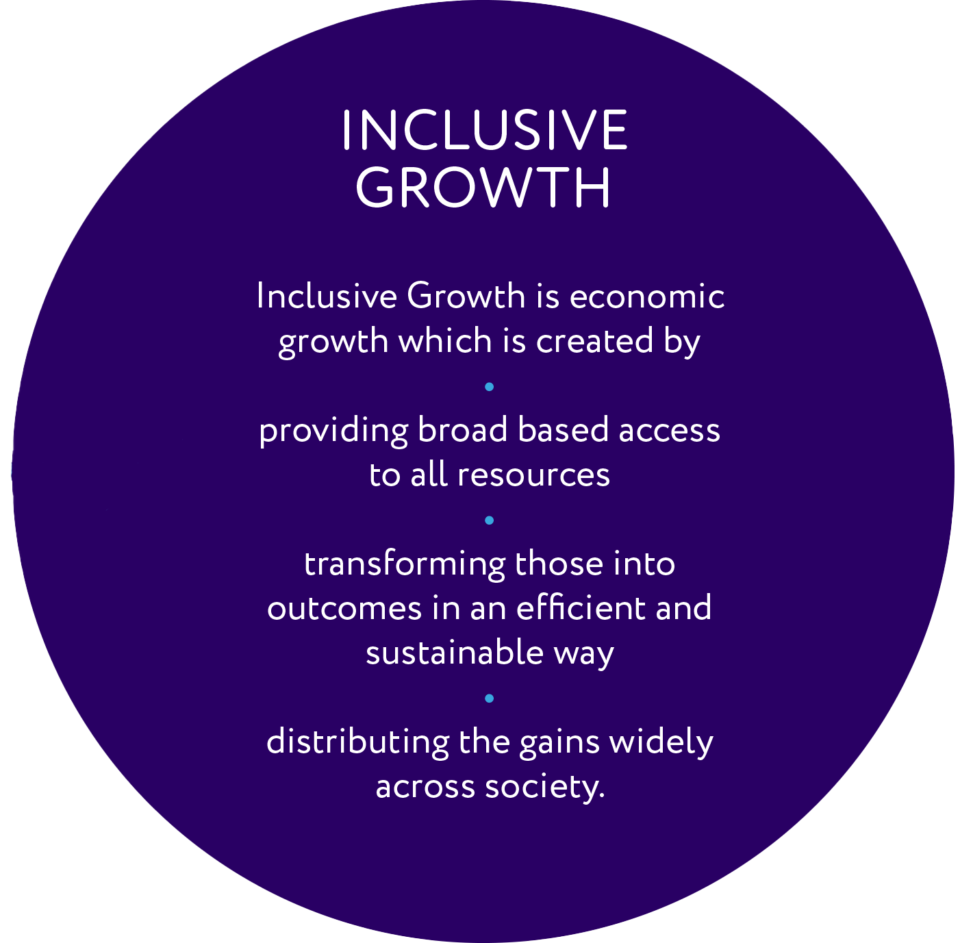
- Ultimately productivity can create inclusive growth – economic prosperity which is created by providing broad access to all resources, transforming them into efficient outcomes, and distributing the gains widely across societies.
For quite some time now, the UK has experienced poor productivity performance relative to its own history and its peers, which has become known as the productivity puzzle.
Despite strong performance around the turn of the century, UK productivity growth has grown more slowly since. While other advanced economies also experienced a growth slowdown, the effect is more accentuated in the UK. And there is no single solution to solve it.
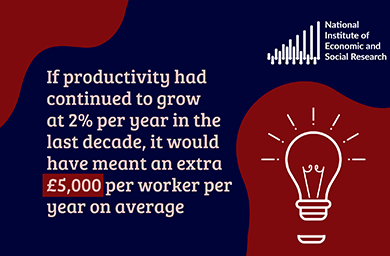
This poor productivity affects everyone. The shortfall caused by the productivity slowdown amounts to some £5,000 per working in the UK – around 20% of average annual earnings.
The Productivity Institute has developed a synopsis of what has caused the UK’s productivity stagnation:
- A chronic and broad-based degree of underinvestment in the UK economy – including physical, human, and intangible capital – both publicly and privately.
- Inadequate diffusion of productivity-enhancing practices between firms and between places, affecting innovation, FDI and supply chain integration.
- High centralisation of policy-making in Whitehall, combined with institutional fragmentation and lack of joined-up policies at the level of regions and devolved nations.
The UK’s economy is more regionally unbalanced than other comparable countries, with many places trapped in a low wage-low productivity-low living standards mode. This makes it difficult for regions outside London to invest in their places.
Evidence from across the OECD shows that second-tier cities can be engines for growth. But when we compare cities like Birmingham, Cardiff, Glasgow, Leeds or Manchester to similar places abroad, they’re all performing much worse.
The UK is firing on only one cylinder and that’s not good for the UK or for London and the South East. Everyone will benefit if we improve productivity across the UK.
Find out more
The Productivity Institute has a number of insights on the UK’s productivity slowdown. The Institute’s Productivity Commission, run by our partner NIESR, creates report summaries demonstrating the scale of the UK’s poor productivity performance.
Report: Productivity in the UK Evidence Review – Productivity Commission
The cost of UK productivity underperformance is laid bare in first report of Productivity Commission.

Research: The Politics of Productivity – institutions, governance and policy
Examining the political institutions, system of governance and policies that have shaped the UK’s poor productivity performance.

Listen: Bart van Ark on why the UK needs an independent productivity institution
Hear the discussion on Wake Up to Money on BBC Radio 5 Live productivity 10:40, with Bart’s commentary beginning two minutes later.
The Productivity Agenda is a blueprint for boosting the UK’s productivity . It features 10 chapters highlighting key policy areas of focus so the public, private and civic sectors can be better equipped to translate productivity gains into improved living standards and well-being across the UK. The chapters have been written by experts from The Productivity Institute.
The Productivity Agenda was launched during National Productivity Week 2023.
The chapters:
- The UK’s productivity challenge: people, firms, and places
- The changing landscape of firm-level productivity – anatomy and policy implications
- Productivity, Innovation and R&D
- Why digitalisation isn’t improving productivity growth
- Skills for productivity growth
- The green transition: Net Zero as an opportunity to improve productivity
- Public Sector Productivity – managing the Baumol cost disease
- Regional productivity, potential causes, and institutional challenges
- A new UK policy institution for growth and productivity – a blueprint
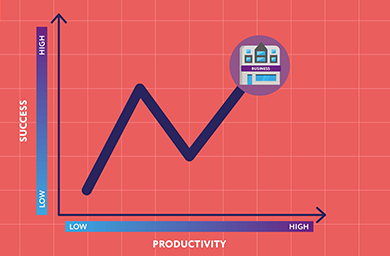
The most successful and profitable businesses are the most productive. Businesses that are more productive are able to produce more output with the same amount of input, which can lead to higher profits and faster growth.
It’s not just efficiency
- Productivity for business is about how an organisation effectively uses its resources (people, machines, knowledge and technology) to improve its performance (profit change). Profit change is driven by what a business does, how it does it, and for what cost.
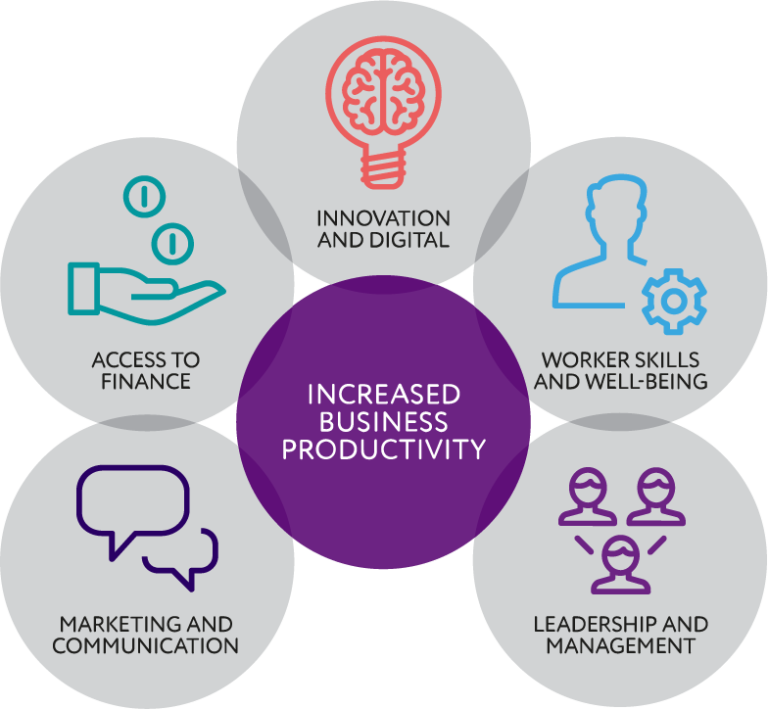
- The Productivity Institute has determined five drivers of business productivity – innovation and digital, worker skills and well-being, leadership and management, marketing and communication and access to finance.
- These drivers work best when strategically aligned with boardroom functions – Finance; Human Resources; Operations, Technology and Digital; and Marketing and Communications
Find out more
Businesses are the main drivers of productivity growth, yet it often remains unclear to leaders exactly how senior leadership teams and boards should be thinking about productivity, and how they can incorporate it into their every day actions to add value. The Productivity Institute has a number of resources to help.

Report: Strategic Productivity for the Leadership Team
Detailing the five drivers of business productivity and how business leaders can work more closely across functions to boost growth.

Briefing: Is there a link between small business leadership and productivity?
Leadership quality has been proposed as an important explanation for differences in the productivity performance between so-called ‘frontier’ and ‘laggard’ firms.
Productivity Puzzles podcast: What makes firms productive?
Listen to data-driven insights and expert opinions converge to shed light on what makes firms truly productive.
The public sector is a key driver of productivity growth. Public sector organisations can facilitate firms and people to make investments in skills, innovation, and create the hard and soft infrastructure at a national, regional and local level. Their services assist private businesses to grow, and contribute to the creation of jobs, higher wages, and a better quality of life.
The public sector itself also stands to gain from improving its productivity levels by generating more value for money. Productivity in the public sector creates higher quality services for customers, enhances employee engagement and motivates people to embrace change.
The key drivers of public sector productivity are:
- Organisation – Adaptive business design
- Technology – Digital transformation
- People – An agile workforce
To put productivity into practice:
- Identify and solve constraints
- Measure and manage performance
- Collaborate and communicate
Find out more
The Productivity Institute has produced a number of resources to help explain how public sector organisations can create practically manage and improve productivity.

Report: Making Public Sector Productivity Practical
Outlining why productivity growth in the public sector is so important and what levers the public sector can use to achieve their goals.
Productivity Puzzles podcast: Making Public Sector productivity practical
Listen to insights on how and why productivity could grow in the public sector from those who work within it.

Blog: Can public services improve their productivity without new funding?
The public sector plays at critical role in times of significant economic and societal challenges, but how can it improve service delivery?
The Productivity Institute has assessed the UK’s subregional productivity performance through a range of indicators and drivers and produced them in a scorecard format.
There are two levels of scorecard, covering:
- 12 regional ITL1 levels
- 179 subregional ITL3 levels

ITL1 scorecards
Disparities between regional productivity performance are significant both across and within UK ITL1 regions and devolved nations. London remains the most productive part of the country in absolute terms, while Northern Ireland appears as the lowest productivity performer.
The ITL1 scorecards cover five main regional productivity drivers – business performance; skills and training; policy and institutions; health and well-being; investments; and infrastructures. These drivers are evaluated using 17 indicators.
ITL3 scorecards
However, the picture at the aggregate ITL1 is not clear cut, with most regions having areas that are doing well and some that could be performing better. The ITL3 scorecards offer greater geographical granularity and can be used as a tool to assess productivity performance relative to other places in the same region or devolved nations as well as the UK as a whole.
The ITL3 scorecards cover five regional productivity drivers – business performance; skills, health and well-being; investment; infrastructure and connectivity. These drivers are evaluated using 15 indicators.
Find out more
Access the ITL1 scorecards and scorecard maps and the ITL3 scorecards through the grid below. All are free to download and use, subject to citations. In addition, explainer blogs which provide deeper analysis of the scorecard methodology are available for both the ITL1 level and the ITL3 level.

Infographics: Productivity scorecards for the 12 ITL1 regions of the UK
Providing an overview of productivity performance for the UK’s 12 regions using five productivity drivers evaluated using 17 indicators.
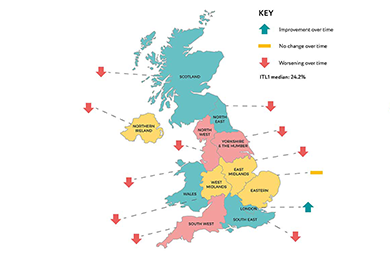
Infographics: Regional visualisations of the 17 productivity drivers in the ITL1 scorecards
Providing a snapshot of how each of the UK’s regions and devolved nations have fared in the short and long term on key productivity metrics.

Infographics: Productivity scorecards for the 179 ITL3 sub-regional areas of the UK
Providing inter-regional and intra-regional comparisons within the UK’s devolved regions and nations using five productivity drivers evaluated using 15 indicators.

Is the UK Productivity Puzzle anywhere closer to being solved? Where do we see progress? And what are the pieces of the jigsaw that still need to be found? This episode of our podcast Productivity Puzzles, released during National Productivity Week 2023, examines the outlook for productivity growth and the best policies that will lead to better outcomes.
Host Professor Bart van Ark is joined by:
- Ed Balls, Former Secretary of State and Shadow Chancellor; Professor of Political Economy at King’s College, London, a Research Fellow at the Harvard Kennedy School.
- Andy Haldane, CEO of the Royal Society of Arts; Chair of Levelling Up Advisory Council.
- Rachel Wolf, Founding Partner at Public First; Former education and innovation adviser to the Prime Minister.
The UK has some of the highest regional inequalities of any advanced country and is one of the most centralised countries in the industrialised world. The latest strategy to tackle regional inequality began in 2019, with a pledge to “level up” the UK.
A subsequent White Paper in 2022 focused on reducing regional inequalities to drive productivity and growth across the whole UK, proposing a “revolution in local democracy” as a solution. However, the scale of the challenge to revolutionise the constitutional and economic models away from the centralised Westminster system of government is considerable.
Some of the structural factors contributing to UK regional inequality include over-centralisation; weak, ineffective institutions and policy churn; institution and policy silos; short-termism and poor-quality policy co-ordination.
A stable institutional landscape; a clear devolution and decentralisation strategy; and coordination between institutions at all levels can help as well as learning lessons from past initiatives.
Find out more
The Productivity Institute has a number of resources that explain the causes and challenges in addressing regional inequality.

Blog: Why are there regional disparities?
Analysing why UK regional disparities exist, how they originated, why they are persisent and why policy has been largely ineffective in dealing with them.

Blog: Institutions, Governance and the politics of ‘Levelling Up’
Understanding the importance of institutions and governance in improving productivity and tackling regional inequality.
Research: The Politics of Productivity – institutions, governance and policy
Examining the political institutions, system of governance and policies that have shaped the UK’s poor productivity performance.
The productivity growth slowdown in advanced economies during the early decades of the 21st century has led to renewed interest in economic measurement. While measured productivity growth has largely evaporated, yet in many ways the average person is better off than at any time in history and technological advance is ever evident. Are we simply, or at least in part, mis-measuring productivity change?
The modern economy is more global, more digital and more complex than in the past. Productivity can be measured for economies, regions, industries, and firms, each of which bring their own challenges and insights. Current productivity measures also don’t always capture intangible and human capital, the environment and welfare.
Find out more
The Productivity Institute has a number of resources to explain productivity measurement.

Research: Productivity Measurement – Reassessing the production function from micro to macro
Five key themes to consider with productivity measurement and analysis.

Research: Recent trends in Firm-Level Total Factor Productivity in the UK – New Measures, New Puzzles
Examining the productivity performance of the UK economy since the financial crisis.

Blog: Greening productivity measurement
Could productivity growth drive both economic growth and the Net Zero Transition.

For more than 75 years, the UK has been grappling with the question of productivity. From 1962-63, the UK held a Productivity Year. To help explain the concept of productivity, Gross National Product and ways in which production can be improved, this video was produced by acclaimed animator Bob Godfrey, using the made-up descriptor of TOTO.

